1. Overview
2. Study Examples
3. Videos
5. Conservation Connection
4. Scientific Publications
6. Investigators
Project Title: Predatory Behavior of Great White Sharks
Overview
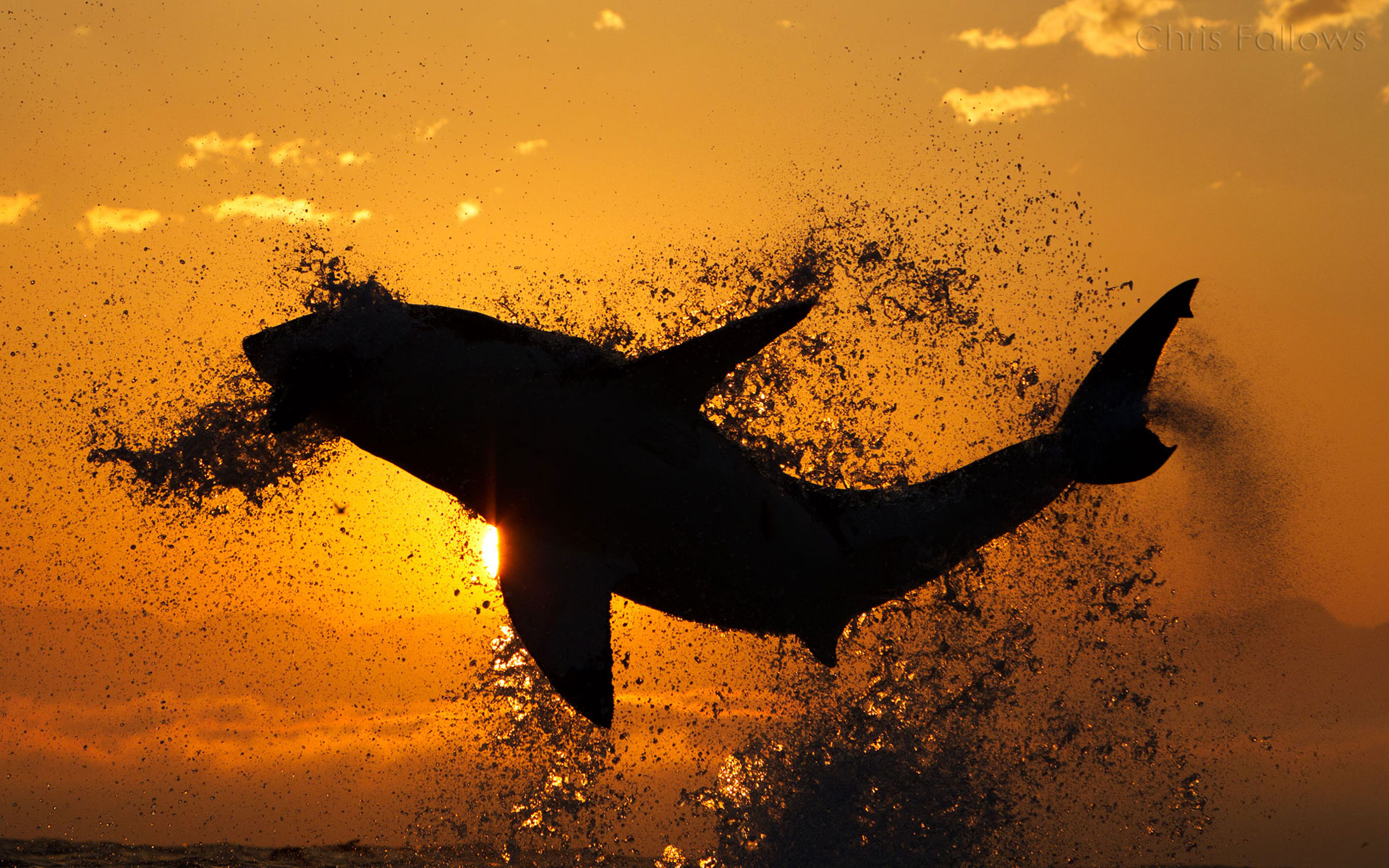
Sharks are apex predators throughout the ocean, yet relatively few studies have quantified or determined factors influencing their hunting behavior and predatory success rates. The waters surrounding Seal Island in False Bay, South Africa, provide a unique opportunity to study predator-prey interactions involving Great White Sharks (hereafter white sharks). During the winter, white sharks visit Seal Island to hunt Cape fur seals. About 48% of surface attacks on seals result in successful kills. Attack frequency is high, averaging 6.68 per day, with as many as 43 recorded in a single day. Sharks attack seals on the surface via a sudden vertical rush, which propels predator and prey out of the water in an awesome display of power and acrobatic prowess.
Some of the major questions we are currently investigating include:
- Do white sharks make hunting decisions that optimize probability for prey capture?
- What behaviors do sharks employ when hunting and attacking seals?
- Do sharks exhibit evidence of learning or social behavior? If so, can these factors affect shark attack success rates?
- Do white shark teeth function as mechanosensory structures, fostering tactile investigation?
- Are shark hunting patterns at Seal Island random, clustered or dispersed?
- What behaviors do seals use to avoid being attacked?
- Do environmental factors influence a white shark’s ability to successfully capture seals and/or the seals’ ability to avoid being attacked?
Recent Study Highlights & Examples
White sharks appear to hunt solitary juvenile Cape fur seals near their primary entry and exit point early in the morning, when light levels are low. Stalking is conducted from near the bottom, from sufficient depth to remain undetected during approach, and the attack launched vertically. This strategy maximizes a shark’s chance of catching a seal unaware, resulting in a fatal or incapacitating initial strike. Stealth and ambush are key elements in the white shark’s predatory strategy. Further, recognizable individual white sharks display distinct predatory strategies and some enjoy a predatory success rate of roughly 80%. Moreover, spatial patterns of shark predation at Seal Island are nonrandom. Sharks station themselves at specific points which represent an optimal balance among prey detection, capture rates, and competition. Smaller sharks exhibit more dispersed prey search patterns and have lower predatory success rates than larger conspecifics, suggesting possible learning with experience.
FIGURE (right): (A) Peak 1% geoprofile of 340 white shark attacks on Cape fur seals at Seal Island, South Africa, over primary seal travel path from and returning to the island (a triangle originating at LP and widening to the south; see Figure 1B); the geoprofile shows a strong, well-defined anchor point. (The ranges for the z-score — the likelihood value of the anchor point for a given pixel in a geoprofile — are depicted with different colours, outlined in the legend). Peak 1% geoprofiles of white shark attacks at Seal Island by total length, showing increasing focus of anchor point with increasing size (i.e., experience): (B) small sharks (<3 m); (C) medium sharks (3-3.5 m); and (D) large sharks (>3.5 m).Figure from Martin et al. 2009. Journal of Zoology, 279: 111-118
Videos
Sharks Hunt Like Serial Killers
Discovery News
Great white sharks may hunt for food, but the predators use tactics often seen among human serial killers. Jorge Ribas reports on the new study’s findings.
False Bay
White Shark Manifesto
RJD Scientist Austin Gallagher created a series of video blogs chronicling the 2011 South Africa White Shark trip with Dr. Neil Hammerschlag.
This segment is a brief intro to the fauna of False Bay, South Africa—our home for the next two weeks.
The Cage
White Shark Manifesto
RJD Scientist Austin Gallagher created a series of video blogs chronicling the 2011 South Africa White Shark trip with Dr. Neil Hammerschlag.
This segment highlights their first shark diving encounter with the white sharks.
The First Breach
White Shark Manifesto
RJD Scientist Austin Gallagher created a series of video blogs chronicling the 2011 South Africa White Shark trip with Dr. Neil Hammerschlag.
This segment highlights their first white shark breach experience. 2 Tons of white shark leaping out of the water, featuring video, stills, and interviews post-breach.
False Bay White Sharks
By Rob Lawrence, African Shark Eco-Charters
Experience ten minutes of heart-stopping breaches and hunting behavior from South Africa’s fiercest Great White Sharks.
Hammerschlag N. 2004. Factors affecting predatory success of White Sharks (Carcharodon carcharias) at Seal Island in False Bay, South Africa. Nova Southeastern University Publication, Masters Thesis, 85 pp